Which Vanity Cabinet Model Fits Which Hotel Category? Economy, Midscale, Upscale and Luxury Compared
Choosing a vanity cabinet by hotel category is mostly about matching model type, materials and detailing to guest expectations and operating reality. This guide compares the four tiers side by side so you can specify with confidence.
The right vanity cabinet by hotel category depends on what guests expect at that price point and what your housekeeping and maintenance teams can realistically sustain. An economy property needs a robust, simple unit that is quick to clean and replace. A luxury hotel needs a piece that looks like furniture and still survives daily wet use. This guide maps the main model types to each tier and shows the features that separate one level from the next.
Why the hotel category should drive the vanity model
Vanity cabinets are specified in every bathroom, so small choices are multiplied across the whole room count. A detail that is affordable in 30 suites can become a serious budget item in 300 standard rooms.
At the same time, the bathroom is where guests judge quality most closely. A loose basin, a swollen door edge or a dated finish is noticed immediately, whatever the star rating or brand tier.
Category labels vary between markets and brands, so treat the tiers below as practical groupings rather than formal classifications. Always check your brand standards or operator brief first.
The four tiers at a glance
| Feature | Economy | Midscale | Upscale | Luxury |
|---|---|---|---|---|
| Typical model type | Compact wall-hung or simple floor-standing unit | Wall-hung unit with one or two drawers | Wall-hung or console with integrated storage | Bespoke double vanity, console or built-in joinery |
| Carcass board | Moisture-resistant MDF or HPL-faced board | Moisture-resistant board with sealed edges | HPL, marine plywood or equivalent | Marine plywood or high-grade moisture-resistant core |
| Top and basin | Laminate or integrated moulded top | Solid surface or quartz | Quartz, solid surface or selected stone | Natural or book-matched stone, cast stone |
| Hardware | Standard soft-close hinges | Soft-close, corrosion-resistant | Soft-close, stainless or coated, concealed runners | Premium runners, tailored handles or push-open |
| Lighting and mirror | Separate mirror | Mirror, optional LED | Integrated LED mirror | Designed lighting, backlit edges, bespoke mirror |
| Design variation | One model across rooms | Two or three variants | Several variants by room type | Variant per suite type, often unique |
Economy hotels: simple, robust and replaceable
In economy and budget properties, the priority is durability per unit cost and fast housekeeping. The bathrooms are often compact, so slim depths and minimal projecting parts matter more than decoration.
Typical model choices
- Compact wall-hung unit with a single door or a single drawer, leaving the floor clear for mopping.
- Simple floor-standing cabinet where plumbing is already fixed and the wall cannot carry load.
- Open shelf or washstand in some concepts, which removes doors and hinges from the maintenance list.
What separates this tier
Fewer variants, standard sizes and plain fronts keep production efficient. The key is not to save on the parts that fail first: edge sealing, hinges and the junction between top and wall. A low-cost unit with poor sealing will cost more in replacement than a slightly better specified one.
Midscale hotels: balancing operations and appearance
Midscale hotels usually need a consistent look across many rooms, with a bit more storage and a better feel. Guests expect a proper drawer, a decent top and a mirror that works with the lighting.
Typical model choices
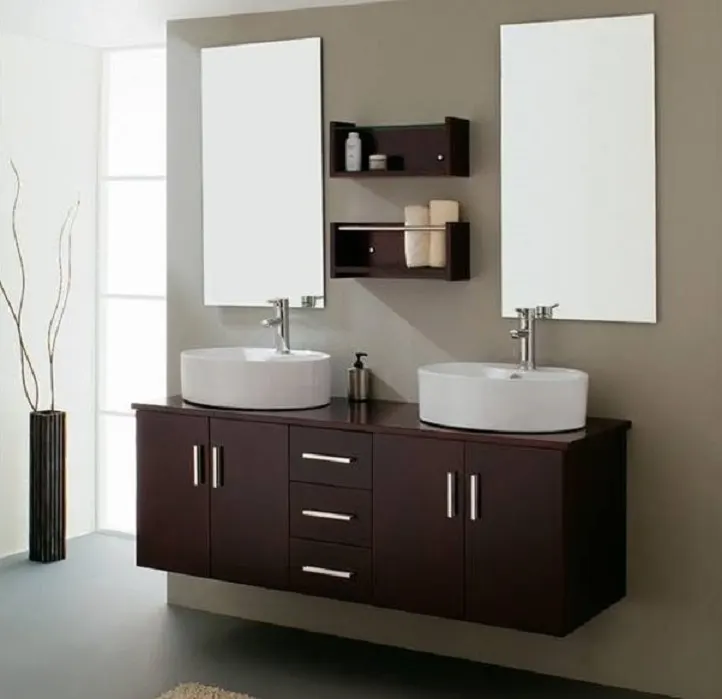
- Wall-hung vanity with one or two drawers for amenity storage and a clean visual line.
- Floor-standing unit with plinth where the brand prefers a more solid appearance.
- Integrated top and basin in solid surface or quartz, which reduces joints and simplifies cleaning.
What separates this tier
The step up from economy is mostly in the top, the soft-close hardware and the finish. HPL or good-quality laminate fronts, sealed edges and corrosion-resistant fittings help the unit look right in year three and beyond. This is also the tier where limiting variants across room types gives the biggest cost benefit.
Upscale hotels: storage, lighting and detail
In upscale properties the vanity starts to behave like a piece of furniture. Guests expect usable storage, a well-lit mirror area and details that feel considered.
Typical model choices
- Wall-hung or console-style vanity with drawers, a hair dryer holder or a towel shelf.
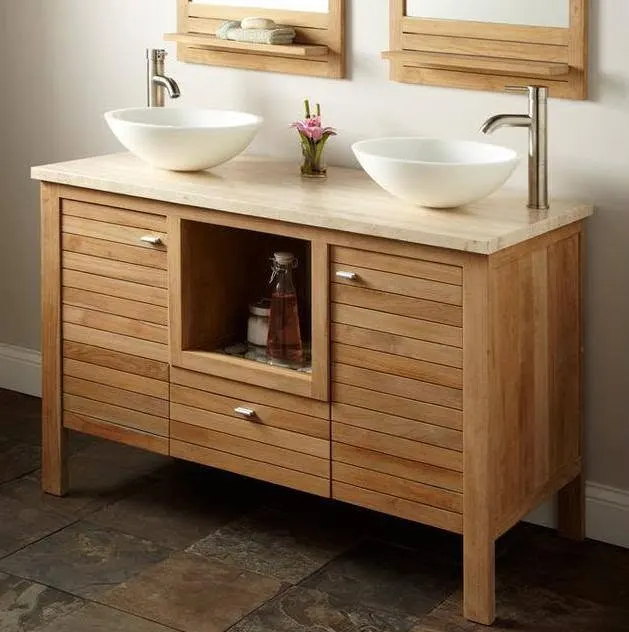
- Single or double basin layouts depending on the room type and bathroom size.
- Undermount or integrated basins for a cleaner top surface.
What separates this tier
Look for concealed runners, plumbing access that does not require removing the unit, and integrated LED lighting planned with the electrical drawings. Veneer, lacquer or high-quality laminate fronts can all work, provided the edges and joints are properly sealed. Natural timber looks need particular care in humid bathrooms.
Luxury hotels: bespoke joinery and material quality
At the top of the market, the vanity is part of the room's identity. It is often designed with the architect or interior designer and produced to project drawings, sometimes in different versions for each suite type.
Typical model choices
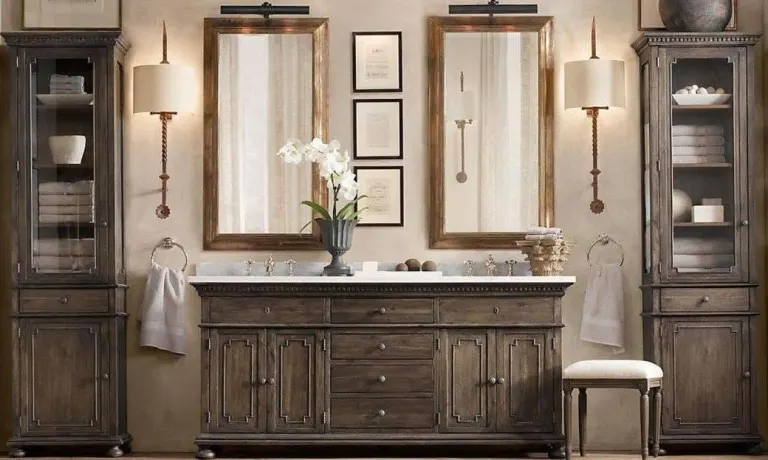
- Double vanity for suites, with generous top length and storage on both sides.
- Console or freestanding washstand with a metal frame and stone slab.
- Built-in joinery that runs into wall panelling or a dressing area.
What separates this tier
Natural stone tops, book-matched patterns, fine veneer detailing and metal inlays are common. These features raise the demands on the carcass: heavy tops need proper support, wall fixings must be coordinated with the building structure, and finishes must be matched carefully across doors, tops and wall panels. Mock-up samples are especially valuable here.
Features that change the most between tiers
Across all four levels, a handful of decisions do most of the work in separating one tier from another:
- Top material: laminate and moulded tops at the lower end, solid surface and quartz in the middle, stone at the top.
- Board and edge quality: the carcass core and edge sealing determine service life more than the visible finish.
- Hardware: soft-close is common from midscale up; runner type, handle design and corrosion resistance refine the level.
- Integrated extras: lighting, power, amenity storage and plumbing access appear as you move up.
- Degree of customisation: from one standard model to bespoke pieces per suite.
Do not over-specify or under-specify
Over-specifying wastes budget on details guests will not notice in a limited-service property. Under-specifying creates early maintenance problems and guest complaints, particularly in humid climates or in hotels with high occupancy.
A useful test is to ask what the guest sees and touches daily, and what housekeeping and engineering must repair. Spend where those two lists overlap: the top, the front edges, the hinges and the joints.
Practical tips for developers and procurement teams
- Start from the brand standard or operator brief, then confirm which items are fixed and which can be adjusted.
- Group room types and reduce variants wherever the design allows.
- Ask for a mock-up bathroom before approving a large order, whichever tier you are building.
- Agree on who supplies basins, taps and stone tops so that cut-outs and drawings are coordinated.
- Check local fire, emission and plumbing requirements for the destination market early.
Next step
If you are planning a new hotel or a renovation, send us your bathroom elevations, room schedule or brand specification. We will suggest vanity models suited to your category, outline material options and advise on lead time and shipping for your project.
Sıkça Sorulan Sorular
What is the main difference between economy and luxury hotel vanity cabinets?
The biggest differences are the top material, degree of customisation and integrated features. Economy units use simple compact designs with laminate or moulded tops, while luxury hotels use bespoke pieces with stone tops, designed lighting and detailed joinery. Carcass quality and edge sealing matter at every level.
Should midscale hotels choose wall-hung or floor-standing vanities?
Both work. Wall-hung units make floor cleaning easier and look lighter, but need a wall that can carry the load. Floor-standing units suit walls with limited support or fixed plumbing. Your choice should reflect the wall construction, cleaning routine and brand design guidelines.
Is a double vanity necessary in upscale hotels?
Not for every room. Double vanities add value in suites, family rooms and larger bathrooms where two guests use the space together. In standard rooms, a single basin with good counter space and storage usually earns its floor area better.
Can economy hotels use the same materials as luxury hotels?
Some materials overlap, such as moisture-resistant boards and HPL, but the quantity, finish level and customisation differ. Economy projects typically limit variants and choose practical surfaces, while luxury projects invest in stone, veneer details and custom hardware.
How many vanity models does a hotel typically need?
It depends on the number of room types and the brand standard. Economy and midscale hotels often use one to three variants, while luxury hotels may need a different design per suite type. Fewer variants generally simplify production, reordering and spare parts.
When should I request a vanity cabinet quotation?
Ideally once bathroom layouts and the room schedule are reasonably fixed but before final finishes are locked. Early input from the factory helps align dimensions, materials and plumbing positions, and avoids changes later in the design process.
Every hotel project is different. Send us your drawings or room schedule for a tailored proposal on materials, lead time and shipping.