
Lacquer Bathroom Cabinets with Shutter-Style Doors: Monolithic Wet-Zone Coating Chemistry, Precision Louver Milling, HMR Substrates, and Coastal Architectural Design
Lacquer Bathroom Cabinets with Shutter-Style Doors combine the timeless architectural elegance and passive ventilation benefits of louvered cabinetry with the seamless, moisture-impervious protection of multi-coat catalyzed polyurethane finishes. While natural timber shutter doors offer organic warmth, unpainted or thinly oiled wood louvers can absorb airborne shower steam, warp at tenon joints, or trap soap residue in humid environments. By contrast, Lacquer Bathroom Cabinets with Shutter-Style Doors encase every angled louver slat, beveled stile, and recessed mortise pocket inside a continuous, chemically cross-linked polymer shell—creating a non-porous, wipe-clean facade engineered to withstand decades of high-humidity bathroom exposure.
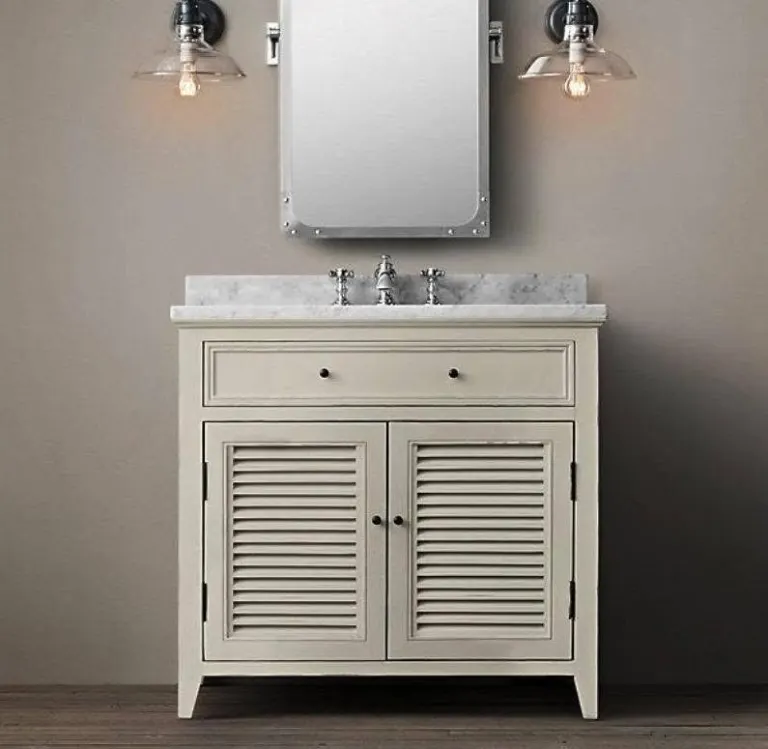
However, manufacturing Lacquer Bathroom Cabinets with Shutter-Style Doors to an international architectural standard is among the most demanding processes in bespoke cabinetry. A single louvered vanity door presents dozens of narrow horizontal edges, sharp interior angles, and tight air gaps where liquid primer can bridge, drip, or leave thin bare spots if sprayed improperly. Whether you are a homeowner planning a spa-grade bath renovation, an interior architect specifying custom coastal or neoclassical joinery, or a B2B buyer sourcing high-specification vanities from leading automated spray facilities in Istanbul, İnegöl, Izmir, or Milan, understanding the substrate engineering, CNC louver routing, multi-angle robotic spraying, and hardware corrosion standards behind Lacquer Bathroom Cabinets with Shutter-Style Doors guarantees zero swelling, zero yellowing, and effortless maintenance.
1. Structural Engineering: Three Manufacturing Architectures for Lacquered Shutter Doors
Not all Lacquer Bathroom Cabinets with Shutter-Style Doors are fabricated the same way. Depending on whether the project requires true convective airflow (for towel linen towers and hamper pull-outs) or dust-sealed storage (for vanity drawers beneath basins), industrial manufacturers deploy three distinct structural methods:
Construction Architecture Core Substrate & Milling Method Airflow & Moisture Performance Optimal Bathroom Application
1. Pre-Primed Mortised Open-Slat Louver Door 20–22 mm Green-Core HMR MDF stiles & rails with individual 7 mm HMR MDF louvers tenoned at a 38°–45° downward pitch into CNC mortise pockets. True passive ventilation (4–7 mm air gaps between slats) + complete 6-sided lacquer seal inside mortise joints. Towel linen cabinets, laundry hampers, and under-sink cabinets needing continuous air circulation.
2. Monolithic CNC-Routed Faux-Louver Slab Door Single solid 22 mm Green-Core HMR MDF panel deeply routed on a 5-axis CNC nesting center using custom-ground angled V-grooving cutters. 100% monolithic seam-free lacquer coating (zero glue joints to ever crack) + dust-sealed interior storage. Under-basin vanity drawers, cosmetic storage, and high-splash zones directly beside open walk-in showers.
3. Hybrid Hardwood Frame with HMR MDF Louvers Kiln-dried 6%–8% EMC Hard White Maple or Tulipwood stiles/rails paired with precision-milled HMR MDF louvers. Superior screw-holding strength at hinge plates + ultra-smooth, grain-free lacquer finish across louver slats. Tall floor-to-ceiling linen tower doors (>1600 mm) requiring high structural rigidity against twisting.
Why Green-Core HMR MDF Outperforms Solid Wood Under Pigmented Lacquer
When specifying opaque colored Lacquer Bathroom Cabinets with Shutter-Style Doors (such as pure white RAL 9003, warm alabaster RAL 9010, coastal sage green, or deep navy), High Moisture Resistant (HMR) green-core MDF (780–820 kg/m³) is superior to solid wood for louver slats. Solid timber expands and contracts across its width with seasonal bathroom humidity shifts, which can create hairline paint cracks where each louver meets the vertical stile. HMR MDF—bonded with waterproof Melamine-Urea-Formaldehyde (MUF) resins—exhibits a 24-hour thickness swelling rate under 5%–6% and zero cross-grain expansion, keeping lacquer films completely unbroken.
2. Precision CNC Milling and Pre-Assembly Finishing Protocols
The primary failure mode in low-grade louvered cabinetry is uncoated raw edges inside the narrow gaps between slats, which wick bathroom condensation into the core. Premier facilities producing Lacquer Bathroom Cabinets with Shutter-Style Doors prevent this through a specialized pre-priming and micro-radiusing workflow:
1. 1.5 mm Micro-Radiusing on Every Louver Edge: Liquid coatings naturally pull away from sharp 90-degree corners due to surface tension (edge-thinning). Prior to assembly, every louver slat passes through a profile moulder or CNC cutter to mill a 1.5 mm rounded bullnose edge along both front and rear lips, ensuring uniform dry film thickness (140–180 microns) across every edge.
2. Pre-Assembly Slat Isolation & Priming: For true open-slat doors, manufacturers spray individual louver slats and routed stile pockets with two-component (2K) polyurethane edge isolator and high-build primer before assembling the door. This guarantees that even the hidden tenon ends inside the mortise slots are hermetically sealed against steam.
3. Waterproof D4 / PUR Tenon Bonding: Louvers are assembled into the stiles using waterproof D4 cross-linking PVAc or Polyurethane (PUR) adhesive in pneumatic frame clamps, squaring the door within ±0.3 mm diagonal tolerance.
4. Automated Brush Denibbing: Cured primer coats are sanded smooth using flexible rotary abrasive brush sanders (320- and 400-grit strips) that reach cleanly into every louver recess without rounding crisp architectural lines.
3. Multi-Angle Coating Chemistry: Defending Louvers Against Steam and UV
Because bathroom environments combine intense moisture vapor with bright vanity lighting and natural daylight, Lacquer Bathroom Cabinets with Shutter-Style Doors require specialized two-component (2K) catalyzed coating systems:
Aliphatic Acrylic-Polyurethane Topcoats (Non-Yellowing)
• Why Aliphatic Chemistry Matters: Standard aromatic polyurethane lacquers gradually amber when exposed to UV light from bathroom windows or LED vanity sconces—turning crisp white louver doors noticeably yellow within 3–5 years. Top-tier manufacturers utilize non-yellowing aliphatic acrylic-polyurethane topcoats (sourced from Italian and German chemical leaders such as Sayerlack, Renner, ICA, and Hesse-Lignal) that maintain color stability (Delta-E < 0.5) for decades.
• Four-Angle Pressurized Spray Application: Inside positive-pressure, HEPA-filtered spray booths (maintained at 22°C–24°C and 50%–55% RH), multi-axis spray arms coat shutter doors from four opposing 45-degree angles (top-down, bottom-up, left-to-right, and right-to-left) so both the upper and lower faces of every angled louver receive full, uniform film build without runs or dry spray.
Optimal Sheen Selection for Lacquered Shutter Doors
Sheen Level Specular Gloss (60°) Performance on Lacquer Bathroom Cabinets with Shutter-Style Doors
Silk Satin / Eggshell 20 – 30 GU Most recommended sheen. Repels water droplets effortlessly, resists soap-scum adhesion, and diffuses light softly across angled slats without highlighting dust.
Velvet Super-Matte (Anti-Fingerprint) 4 – 8 GU Ideal for contemporary architectural bathrooms in muted sage, greige, or charcoal; incorporates elastomeric silica additives for a soft-touch, smudge-resistant surface.
Mirror High-Gloss 90+ GU Not recommended for open-slat shutter doors—polishing compounds cannot be buffed cleanly between narrow slats, and bright reflections accentuate dust.
4. Waterproof Carcass, Floating Vanity, and Hardware Engineering
A seamless lacquered shutter front must be backed by equally moisture-proof structural box construction and marine-grade hardware:
• Phenolic Marine Plywood (Su Kontrası) or 18 mm HMR MDF Carcasses: All interior cabinet boxes, shelves, and top stretcher rails should be built from 18 mm–20 mm phenolic marine plywood (24-hour swelling ≤ 3%) or 18 mm green-core HMR MDF edge-banded with waterproof PUR hot-melt adhesive or zero-joint laser ABS edge-banding.
• 8 mm – 10 mm Grooved Structural Back Panels: Inset into deep rear CNC channels to deliver diagonal rigidity for wall-hung floating vanities.
• Wall-Hung Floating Vanity Brackets: Elevating Lacquer Bathroom Cabinets with Shutter-Style Doors 250 mm–350 mm off the tiled floor keeps the bottom shutter rails away from wet mopping water and shower splash zones. Specify concealed steel wall-suspension brackets (Camar 807 XL or Hettich SAH 216, rated 120 kg–240 kg per pair) anchored into solid masonry or internal 2x8 timber wall blocking.
• AISI 304 Stainless Steel & Marine Nickel Hinges: Open louvers allow humid air to circulate inside the cabinet, exposing hinges to ambient moisture. Mandate AISI 304 stainless steel or marine-nickel soft-close concealed hinges (Blum Clip top Blumotion, Hettich Sensys, Salice Silentia+) tested to EN ISO 9227 salt-spray corrosion resistance standards.
• U-Shaped P-Trap Cutout Drawers & Aluminum Drip Trays: Pair faux-louver upper vanity drawers with full-extension undermount runners (Blum Movento / Hettich Quadro) featuring CNC-milled U-shaped plumbing cutouts lined with anodized aluminum trim, plus a full-width anodized aluminum waterproof drip tray on the bottom floor of the sink cabinet.
5. Architectural Design Pairings and Effortless Cleaning Protocols
Lacquer Bathroom Cabinets with Shutter-Style Doors bridge classic craftsmanship and crisp modern minimalism across multiple design styles:
• Modern Coastal & Mediterranean Spa: Warm white (RAL 9010) or soft sand silk-satin shutter vanities paired with honed limestone or Calacatta-veined engineered quartz countertops, undermount porcelain basins, and unlacquered brass or brushed nickel fixtures.
• Contemporary European Minimalism: Floating handleless J-pull shutter vanities finished in super-matte eucalyptus green or warm greige, illuminated from underneath by IP65 waterproof 2700K COB LED strips recessed into anodized aluminum channels.
• Neoclassical & Transitional Master Baths: Floor-to-ceiling inset shutter linen towers flanking a freestanding soaking tub, providing ventilated storage for plush bath sheets without visual bulk.
Maintenance Best Practices for Lacquered Louvers
Because 2K catalyzed polyurethane creates a smooth, non-porous, glass-like skin over the slats, cleaning Lacquer Bathroom Cabinets with Shutter-Style Doors is dramatically easier than maintaining raw or oiled wood shutters:
1. Routine Dry Dusting: Sweep downward across the louvers once a week with a soft vacuum brush nozzle or electrostatic microfiber wand.
2. Monthly Damp Wipe: Wipe slats with a plush microfiber cloth lightly dampened with warm water and a drop of pH-neutral mild dish soap, followed immediately by a dry microfiber cloth. Avoid ammonia, bleach, acetone, or abrasive melamine foam sponges.
3. Exhaust Ventilation: Run a humidistat-controlled bathroom exhaust fan (8–10 air changes per hour) during and for 15 minutes after hot showers to keep relative humidity below 60%.

