
What Should You Consider When Choosing Solid Wood Kitchen and Bathroom Cabinets? The Definitive Architectural, Timber Science, and Engineering Buyer’s Guide
What Should You Consider When Choosing Solid Wood Kitchen and Bathroom Cabinets? Answering this question requires looking far beyond surface woodgrain aesthetics and showroom lighting. While natural timber brings unmatched warmth, acoustic dampening, tactile authenticity, and multi-decade longevity to residential and commercial interiors, kitchens and bathrooms are the two most hostile microclimates inside any building. Boiling steam, cooking grease aerosols, acidic spills, radiant oven heat, and 85%+ relative humidity after hot showers relentlessly test the structural integrity of wooden joinery.
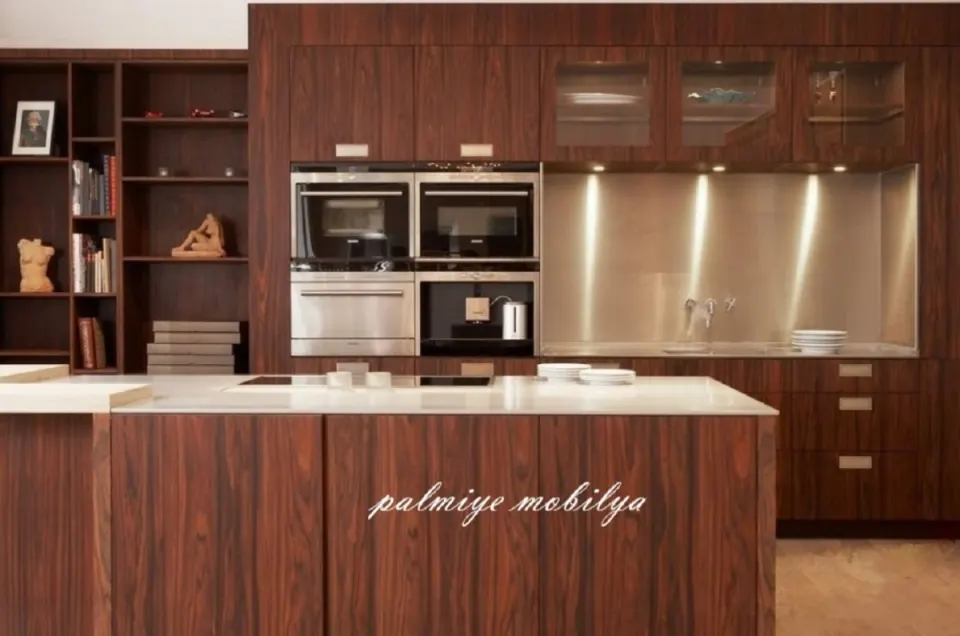
Whether you are a homeowner investing in a bespoke renovation, an interior architect specifying luxury millwork, or an international developer sourcing high-end cabinetry from premier manufacturing hubs in Türkiye, Italy, or North America, knowing What Should You Consider When Choosing Solid Wood Kitchen and Bathroom Cabinets? protects your project from seasonal door warping, split frame joints, water-damaged sink bases, and prematurely yellowing finishes. This comprehensive technical guide breaks down every timber science, construction, hardware, and environmental factor required to specify and evaluate true architectural-grade solid wood cabinetry.
1. Hardwood Species Selection: Cellular Structure, Hardness, and Moisture Resistance
The first pillar of What Should You Consider When Choosing Solid Wood Kitchen and Bathroom Cabinets? is selecting the right botanical hardwood species. Not all hardwoods perform equally in wet zones; cellular pore structure, natural extractives, and volumetric shrinkage ratios dictate how a cabinet door behaves over twenty years.
Technical Comparison of Premier Cabinetry Hardwoods
Hardwood Species Janka Hardness (lbf / N) Pore Structure & Water Behavior Tangential / Radial Shrinkage Ratio Best Application in Kitchens & Bathrooms
European & American White Oak (Quercus robur / Quercus alba) 1,350 lbf (6,000 N) Closed pores (plugged with tyloses); naturally resists water & rot Moderate (~1.7 – 1.8) Top choice for both kitchens and humid bathroom vanities.
American Black Walnut (Juglans nigra) 1,010 lbf (4,490 N) Semi-ring-porous; naturally durable heartwood extractives Low (~1.4 — highly stable) Luxury contemporary flat-slab veneers, dovetail drawers, and bespoke islands.
Hard White Maple (Acer saccharum) 1,450 lbf (6,450 N) Tight, diffuse-porous grain; high impact & dent resistance Moderate (~2.0) Painted solid-wood shaker frames, heavy-duty drawer boxes, and high-traffic family kitchens.
Thermo-Treated Ash (Fraxinus excelsior) 1,320 lbf (5,870 N) Thermally modified at 190°C–215°C; caramelized wood sugars Ultra-Low (EMC cut by 50%) Exceptional for high-humidity master bathrooms, spa vanities, and coastal homes.
American Cherry (Prunus serotina) 950 lbf (4,220 N) Fine, closed grain; darkens naturally via photo-oxidation Low (~1.5) Traditional/transitional cabinetry (avoid in ultra-high-impact zones due to softer Janka rating).
Red Oak (Quercus rubra) 1,290 lbf (5,740 N) Open, unobstructed vessel pores (absorbs moisture like straws) High (~2.1) Dry-zone cabinetry only; avoid in unsealed bathroom vanities or wet sink bases.
Lumber Cut Orientation: Plain-Sawn vs. Quarter-Sawn vs. Rift-Sawn
• Plain-Sawn (Flat-Sawn): Displays dramatic arched "cathedral" grain patterns. It is the most economical cut, but exhibits the highest cross-grain expansion and cupping tendency during humidity swings.
• Quarter-Sawn & Rift-Sawn: Logs are milled at 60° to 90° angles to the annual growth rings. This produces tight, linear vertical grain lines, eliminates cupping, and reduces seasonal width expansion by nearly 50%—making rift-sawn white oak the gold standard for modern architectural solid wood kitchen and bathroom cabinets.
2. Kiln-Drying Standards and Equilibrium Moisture Content (EMC)
When evaluating What Should You Consider When Choosing Solid Wood Kitchen and Bathroom Cabinets?, internal timber moisture content is the single most critical hidden quality metric.
1. Target Equilibrium Moisture Content (6% – 8% EMC): Freshly felled green hardwood contains 40%–80% water by weight. For interior cabinetry installed in climate-controlled homes (20°C–22°C and 40%–50% relative humidity), timber must be kiln-dried to 6% to 8% EMC prior to milling.
2. Stress-Relief Conditioning: High-end mills conclude kiln cycles with a high-humidity steam conditioning phase to neutralize internal drying stresses (case-hardening). Without stress relief, boards twist and bow the moment CNC routers cut door profiles.
3. Pre-Purchase Verification: When auditing a cabinet manufacturer or inspecting delivered units, verify that the factory enforces a 72-hour warehouse acclimatization rule and uses pinless dielectric moisture meters to reject any timber batch exceeding 8.5% moisture content.
3. Door Construction and Expansion-Tolerant Joinery
Solid wood expands and contracts across its width with seasonal HVAC shifts, while remaining virtually unchanged along its length. Understanding how a manufacturer engineers around wood movement is central to What Should You Consider When Choosing Solid Wood Kitchen and Bathroom Cabinets?.
Five-Piece Shaker & Raised-Panel Joinery
• Haunched Mortise-and-Tenon / Cope-and-Stick Corners: Stiles (vertical frame members) and rails (horizontal frame members) should be 20 mm to 22 mm thick and joined with precision CNC-milled haunched mortise-and-tenon joints rather than simple butt joints or dowels.
• Floating Center Panels with Spaceballs: Never buy five-piece solid wood doors where the center panel is glued rigidly into the perimeter frame. Quality manufacturers float the center panel inside a 10 mm deep groove cushioned by elastomer Spaceballs, allowing the panel to expand 3–4 mm in humid summer weather without splitting the outer stiles.
Why Large Flat-Slab Doors Should Use Thick Veneer Over Engineered Cores
If your architectural design calls for wide, uninterrupted flat-slab doors or floor-to-ceiling 2800 mm tall pantry fronts, a 100% solid glued-plank slab will eventually cup or crack across glue lines. In these applications, the superior engineering choice is thick architectural wood veneer (0.9 mm to 1.5 mm) book-matched or slip-matched over a balanced green-core HMR MDF or multi-ply Baltic birch plywood core, edged with 3 mm to 5 mm solid hardwood lippings.
Concealed Steel Straightening Rods
For tall solid-frame pantry doors and integrated refrigerator panels exceeding 2000 mm in height, specify concealed adjustable steel tensioning rods recessed into the rear door face beneath a flush aluminum cover channel. These rods keep tall doors laser-straight across decades of seasonal climate shifts.
4. Carcass Substrate Engineering: Box Durability in Wet Zones
A common misconception when researching What Should You Consider When Choosing Solid Wood Kitchen and Bathroom Cabinets? is assuming that the hidden interior cabinet box (carcass) must also be solid plank lumber. In fact, solid wood carcasses are excessively heavy and prone to seasonal dimensional shifts that can throw concealed hinges out of alignment.
Optimal Carcass Substrates for Kitchens vs. Bathrooms
• 18 mm – 20 mm Multi-Ply Baltic Birch Plywood (13–15 Cross-Banded Plies): The premier structural carcass material for luxury kitchen cabinets, offering exceptional screw-holding retention, zero shelf sag across 1000 mm spans, and superior structural integrity under heavy 30 mm quartz or natural stone countertops.
• Phenolic Marine Plywood (Su Kontrası): Bonded with waterproof WBP (Weather and Boil Proof) phenolic resins, limiting 24-hour thickness swelling to under 3%. Mandatory for floating bathroom vanities, wet-room cabinetry, and kitchen sink bases.
• 18 mm Green-Core High Moisture Resistant (HMR) MDF: Dense (780–820 kg/m³) moisture-repellent core ideal for painted or lacquered bathroom vanities and contemporary modular carcasses, provided all edges are sealed with waterproof PUR (Polyurethane Reactive) adhesive.
• 8 mm to 12 mm Grooved Structural Back Panels: Avoid cabinets with thin 3 mm stapled hardboard backs. Insist on 8 mm–12 mm veneered plywood or melamine backs inset into deep rear CNC grooves to prevent cabinet racking during transport and wall mounting.
5. Solid Hardwood Drawer Box Construction
Drawer boxes endure the highest mechanical stress of any component in solid wood kitchen and bathroom cabinets:
1. 15 mm – 16 mm Solid Hardwood Sides: Kiln-dried hard maple, American black walnut, or European oak.
2. English Dovetail Corner Joinery: Interlocking trapezoidal pins and tails mechanically lock the drawer front to the sides against thousands of forceful pulls.
3. Inset 8 mm Veneered Plywood Bottoms: Captured inside deep dado grooves 12 mm above the bottom edge of the drawer sides so heavy stacks of ceramic plates or cast-iron Dutch ovens never push the bottom panel out.
4. U-Shaped Plumbing Cutouts (Bathroom Vanities): Top vanity drawers should feature CNC-milled U-shaped cutouts trimmed in solid wood or anodized aluminum to wrap cleanly around sink P-traps without sacrificing side drawer storage.
6. Protective Coating Chemistry: Defending Wood Against Steam, Grease, and Water
Natural wood without industrial-grade catalytic protection will absorb cooking grease, coffee stains, red wine, and bathroom condensation. Knowing What Should You Consider When Choosing Solid Wood Kitchen and Bathroom Cabinets? means scrutinizing the exact finishing chemistry:
• Two-Component (2K) Aliphatic Acrylic-Polyurethane ("Natural Effect" Dead-Matte, 3–5 GU): The highest-performing transparent protective finish for modern wooden cabinetry. Non-yellowing aliphatic isocyanates cross-link into a tough, non-porous barrier compliant with EN 12720 chemical and water-spot resistance while preserving the raw, organic texture of open-pore oak or walnut.
• Industrial UV-Cured Hardwax Oils: Penetrate deeply into wood fibers to enhance grain depth while repelling water droplets. Ideal for homeowners who prefer an organic tactile surface that can be spot-sanded and refreshed locally on-site over the decades.
• Mandatory Six-Sided Sealing: Ensure the manufacturer sprays sealer and topcoat on all six surfaces of every door and panel—including top and bottom edges and inside concealed hinge cup holes—to prevent uneven moisture absorption.
7. Hardware Corrosion Resistance and Structural Mounting
Even master-crafted joinery fails if paired with sub-standard hardware, especially in humid bathrooms and coastal environments:
• AISI 304 Stainless Steel & Marine-Grade Concealed Hinges: Specify Blum Clip top Blumotion (in Onyx Black or stainless steel), Hettich Sensys, or Salice Silentia+ hinges tested to EN ISO 9227 salt-spray corrosion standards, rated for 200,000+ opening cycles.
• Full-Extension Concealed Undermount Slides: Heavy-duty synchronized runners (Blum Movento or Hettich Quadro) rated for 40 kg to 70 kg dynamic loads, mounted invisibly beneath solid dovetail drawer boxes.
• Floating Vanity Wall Brackets: Wall-hung bathroom vanities carry immense dead and live loads (solid wood carcass + marble/quartz top + water-filled basin + leaning weight). Demand concealed structural steel brackets (Camar 807 or Hettich SAH 216) rated at 120 kg–240 kg per pair, anchored directly into solid masonry or double timber wall blocking.
• Aluminum Sink-Base Drip Liners: Require an anodized aluminum waterproof tray across the floor of every kitchen sink base and bathroom vanity basin cabinet to contain minor plumbing drips before they reach the wood.
8. Environmental Certifications and Indoor Air Quality Compliance
When finalizing What Should You Consider When Choosing Solid Wood Kitchen and Bathroom Cabinets?, verify third-party sustainability and health certifications:
• FSC (Forest Stewardship Council) or PEFC Chain of Custody: Confirms timber originates from legally harvested, sustainably managed forests.
• CARB Phase 2 / EPA TSCA Title VI & EU E1/E05 Compliance: Guarantees that any plywood cores, veneers, and structural adhesives emit ultra-low or zero added formaldehyde (NAF — No-Added Formaldehyde).
• Low-VOC Water-Borne or High-Solids Finishes: Protects indoor air quality in tightly sealed modern homes.
9. Essential Pre-Order Buyer’s Verification Checklist
Before signing a purchase contract or releasing a deposit for solid wood kitchen and bathroom cabinets, confirm these seven technical points in writing:
1. Exact Botanical Species & Cut: Specified by Latin name (e.g., Quercus robur rift-sawn) rather than generic "oak" or "hardwood."
2. Kiln-Dried Moisture Guarantee: Documented 6%–8% EMC at the time of fabrication.
3. Wet-Zone Core Upgrade: Phenolic marine plywood or green-core HMR MDF specified for all bathroom vanities and kitchen sink bases.
4. Floating Panel & Straightening Rod Specs: Elastomer Spaceballs inside five-piece shaker frames and concealed steel straightening rods on doors over 2000 mm tall.
5. Six-Sided Catalytic Coating: Non-yellowing 2K acrylic-polyurethane or UV hardwax oil applied equally to front, back, and perimeter edges.
6. Oven & Steam Thermal Shields: Brushed aluminum heat-deflector strips installed alongside built-in ovens and steam ovens.
7. Warranty & Spare Parts Kit: Minimum 5- to 10-year structural warranty against warping/delamination, lifetime mechanical warranty on European motion hardware, and a factory touch-up kit included upon delivery.
