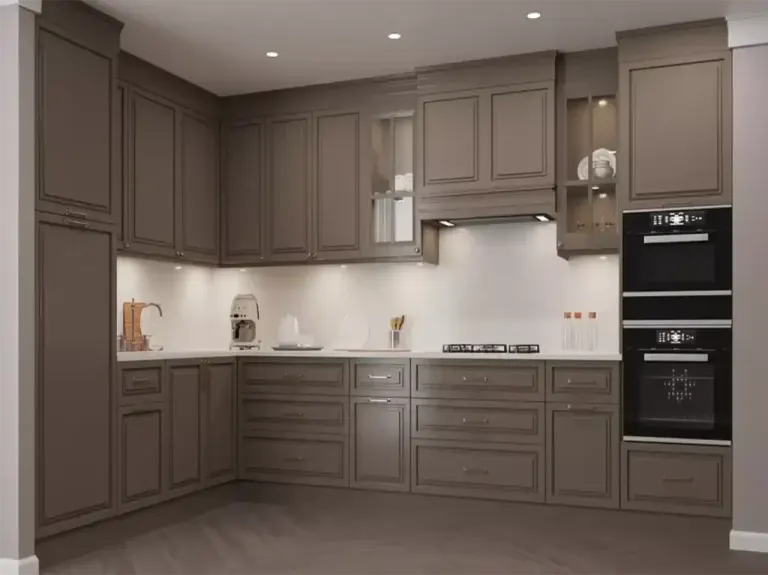
lacquer kitchen cabinets
Lacquer Kitchen Cabinets: The Definitive Engineering, Coating Chemistry, and Architectural Design Guide for 2026 Lacquer Kitchen Cabinets represent the pinnacle of modern residential and luxury architectural millwork. Unlike melamine, thermofoil, or laminated acrylic panels—which rely on adhered surface sheets and edge-banding—true Lacquer Kitchen Cabinets feature a continuous, seamless, chemically cured coating applied directly over high-density Medium-Density Fiberboard (MDF). This monolithic finish eliminates edge seams, prevents moisture penetration along vulnerable perimeter joints, and allows architects and homeowners to execute intricate routed profiles, integrated J-pull handles, and bespoke color matching across virtually any spectrum.
However, not all lacquered cabinetry is engineered to the same standard. The difference between a showroom-grade finish that retains its color and surface integrity for twenty years and a budget finish that chips, yellows, or delaminates within twenty-four months lies entirely in substrate density, primer chemistry, curing environments, and solid-content ratios. This technical guide examines the complete lifecycle, chemical composition, manufacturing tolerances, and maintenance protocols governing high-performance Lacquer Kitchen Cabinets.
1. The Chemistry and Physics of Modern Cabinet Lacquers
In contemporary industrial woodworking, the term "lacquer" has evolved far beyond traditional nitrocellulose finishes. Modern Lacquer Kitchen Cabinets utilize advanced two-component (2K) catalyzed resins or ultraviolet (UV) cured polymers engineered to withstand thermal shock, steam, grease, acidic food spills, and mechanical abrasion.
1. Polyurethane (PU) Two-Component Systems
Polyurethane is the industry benchmark for architectural Lacquer Kitchen Cabinets, widely utilized by leading European and Turkish bespoke manufacturers (utilizing formulations from Italian and German chemical leaders such as Sayerlack, Renner, ICA, and Hesse-Lignal).
• Chemical Mechanism: A base resin (polyol) is mixed with a hardener/catalyst (isocyanate) immediately prior to spraying. This initiates an exothermic cross-linking reaction that forms a dense, non-porous, thermoset polymer network.
• Performance Profile: Exceptional mechanical hardness, high resistance to household solvents and oils, superior flexibility (preventing micro-cracking during seasonal substrate expansion), and outstanding depth of clarity.
• UV Stabilization: Premium PU topcoats incorporate aliphatic isocyanates rather than aromatic isocyanates, preventing photo-oxidation and yellowing when exposed to direct sunlight.
2. Acrylic Polyurethane (Non-Yellowing) Systems
When specifying pure white (such as RAL 9003 Signal White or RAL 9016 Traffic White) or pastel Lacquer Kitchen Cabinets, standard polyurethane can gradually shift toward a warm amber hue over a decade of UV exposure.
• Chemical Mechanism: Acrylic-modified polyurethane utilizes hydroxyl-functional acrylic resins cross-linked with aliphatic polyisocyanates.
• Performance Profile: Virtually zero yellowing over the lifespan of the kitchen, crystal-clear color fidelity, and superior resistance to UV radiation, making it mandatory for bright, south-facing kitchens with expansive glazing.
3. Polyester (PE) High-Build Systems
Polyester coatings are primarily utilized as high-build basecoats (sealers/primers) or ultra-thick mirror-gloss topcoats.
• Chemical Mechanism: Unsaturated polyester resins dissolved in styrene monomer are cured using a peroxide catalyst and cobalt accelerator, achieving nearly 100% solid content (almost zero shrinkage during curing).
• Performance Profile: Creates an extraordinarily thick, glass-like film capable of completely leveling microscopic wood-fiber telegraphing, essential for achieving true piano-grade high-gloss Lacquer Kitchen Cabinets.
4. UV-Cured and Excimer-Cured Industrial Lacquers
Automated flat-line factories utilize UV-curable acrylic/urethane acrylates cured instantaneously under high-intensity mercury or gallium UV lamps.
• Excimer Matting Technology: To produce ultra-matte finishes with extreme scratch resistance, wet UV lacquer is passed through a nitrogen-inerted excimer lamp chamber (172 nm wavelength). The vacuum-UV light causes the microscopic top nanometer layer of the coating to cure and micro-fold instantaneously before the bulk layer cures, creating a velvety, anti-fingerprint surface with a gloss level below 3 GU (Gloss Units).
2. Substrate Engineering: Why MDF Quality Dictates Finish Longevity
A lacquer finish is only as stable as the substrate beneath it. Solid timber expands and contracts cross-grain with fluctuations in relative humidity, which inevitably causes rigid lacquer films to fracture along glue joints. Consequently, engineered Lacquer Kitchen Cabinets rely exclusively on precision-calibrated MDF.
Critical MDF Specifications for Lacquering
1. Board Density (750 – 820 kg/m³): Standard construction-grade MDF (650 – 700 kg/m³) possesses a porous core that absorbs excessive primer and causes edge swelling ("fuzzy edges") after CNC routing. Lacquer-grade MDF (often designated as MDF-LH or Deep-Routing MDF) features a uniform, ultra-fine fiber matrix throughout its core thickness.
2. Panel Thickness (18 mm to 22 mm): While 18 mm is the standard for flat slab doors, 22 mm MDF is preferred for deep-routed neoclassical shaker profiles and integrated J-pull handles to maintain structural rigidity and prevent door warping.
3. Moisture-Resistant (HMR) Green-Core MDF: For sink base fronts, dishwasher panels, and coastal residences, manufacturers utilize melamine-urea-formaldehyde (MUF) bonded HMR MDF, reducing 24-hour thickness swelling to under 6%.
4. Formaldehyde Emission Compliance: High-grade substrates adhere to E1, E05, or CARB Phase 2 / EPA TSCA Title VI standards, ensuring healthy indoor air quality.
3. The Multi-Stage Industrial Lacquering Process
True showroom-quality Lacquer Kitchen Cabinets cannot be achieved in an open workshop. They require pressurized, positive-air-flow spray booths with HEPA filtration, automated reciprocating spray arms, and climate-controlled flash-off tunnels.
Step-by-Step Production Protocol (6- to 8-Coat System)
1. CNC Sizing and Profile Milling: Raw MDF boards are nested and routed using diamond-tipped polycrystalline (PCD) tooling to minimize fiber tear-out on beveled edges and recessed shaker panels.
2. Calibration and Fine Sanding: Panels pass through wide-belt sanders using 180-grit and 240-grit abrasives, while routed profiles are brushed with flexible flap-wheel sanders to knock down raised wood fibers.
3. Barrier / Isolator Coat Application: A low-viscosity polyurethane or polyester isolator is sprayed onto raw routed edges to penetrate and seal the porous MDF core, preventing differential absorption.
4. High-Build Primer Coats (2 to 3 Layers): High-solids white or grey polyurethane/polyester primer (typically 150–200 g/m² per coat) is applied wet-on-wet or with intermediate flash-off periods.
5. Intermediate Denibbing and Orbital Sanding: Once fully cured, the primed panels are sanded dead-flat using 320-grit followed by 400- to 500-grit aluminum oxide abrasives. This eliminates "orange peel" texture and creates mechanical tooth for the color coat.
6. Pigmented Basecoat Application (2 Layers): Custom-tinted polyurethane or acrylic-polyurethane color coats (matched to RAL, NCS, Pantone, or Sherwin-Williams/Benjamin Moore codes) are applied in dust-free booths maintained at 22°C–25°C and 50%–60% relative humidity.
7. Protective Clear Topcoat & Buffing (For High-Gloss): High-gloss Lacquer Kitchen Cabinets receive a clear acrylic-polyurethane topcoat, cure for 7–14 days to reach full cross-link hardness, and undergo multi-stage wet sanding (1000 to 3000 grit) followed by rotary lamb's-wool polishing compounds to achieve a distortion-free mirror reflection.
4. Sheen Levels and Surface Textures: Matte vs. Satin vs. High-Gloss
Selecting the appropriate sheen level for Lacquer Kitchen Cabinets impacts both spatial acoustics/lighting and daily maintenance requirements.
Technical Attribute Super-Matte / Velvet Matte Satin / Eggshell (Silk Matte) Mirror High-Gloss
Gloss Measurement (60° Angle) 3 – 7 Gloss Units (GU) 20 – 35 Gloss Units (GU) 90 – 98 Gloss Units (GU)
Light Reflection Behavior Diffuses light softly; eliminates glare Subtle, warm luster; balanced reflection Reflects light like glass; expands small spaces
Fingerprint & Oil Visibility Low (with Anti-Fingerprint / Soft-Touch additives) Very Low (most forgiving daily sheen) High (shows smudges immediately under raking light)
Micro-Scratch Resistance Moderate to High (Excimer/Nano-matte) High (durable cross-linked topcoat) Moderate (fine swirl marks visible if wiped dry)
Repair / Touch-Up Difficulty High (difficult to blend localized sheen) Moderate (blends best among lacquer sheens) Moderate to High (can be machine-polished out)
Primary Design Styles Minimalist, Japandi, Brutalist, Dark Modern Transitional, Neoclassical Shaker, Contemporary Ultra-Modern, Galley Kitchens, Penthouse Luxury
Soft-Touch (Velvet) Lacquer Additives
Modern super-matte Lacquer Kitchen Cabinets frequently incorporate polyurethane micro-beads or elastomeric silica matting agents into the final topcoat. This creates a warm, tactile, silk-like feel that resists skin oils and significantly reduces burnishing (shiny spots caused by repeated rubbing around handleless edges).
5. Lacquer vs. Competing Cabinetry Materials: Technical Comparison
Specifiers often weigh Lacquer Kitchen Cabinets against acrylic-laminated panels, thermofoil (PVC membrane), and synchronized melamine.
Feature / Metric 2K Polyurethane Lacquer High-Gloss / Matte Acrylic (PMMA) Thermofoil / PVC Membrane Synchronized Melamine (LPL)
Edge Construction Seamless (100% monolithic coating) 1 mm – 1.5 mm ABS/PMMA edge-banding Seamless front/edges; melamine back 0.8 mm – 1 mm PVC/ABS edge-banding
Profile Versatility Unlimited (Shaker, fluted, J-pull, bevels) Flat slab doors only Moderate (soft-routed profiles only) Flat slab doors only
Color Customization Infinite (Any RAL, NCS, or custom match) Limited to factory sheet inventory (30–60 colors) Limited to foil roll catalog Limited to board mill patterns
Moisture Ingress Resistance Exceptional (zero edge seams) High (with PUR/Laser edge-banding) Moderate (vulnerable to steam peeling near ovens) Moderate (depends on edge glue integrity)
Heat Resistance High (thermoset polymer up to ~120°C) Moderate (thermoplastic softens above 80°C) Low to Moderate (delaminates above 70°C) High (thermoset resin surface)
Repairability Refinishable / Repaintable on-site or factory Non-repairable (requires full door replacement) Non-repairable Non-repairable
Relative Cost Tier \((Premium Custom) \vert{}\)\((UpperMid-Range)|{}\) (Mid-Range) – (Economy to Mid-Range)
6. Architectural Door Profiles Enabled by Lacquer
Because Lacquer Kitchen Cabinets are sprayed in liquid form rather than laminated with rigid sheets, fabricators can execute complex geometric door designs impossible with acrylic or melamine:
1. Integrated J-Pull and C-Channel Profiles: The top edge of base doors or bottom edge of wall doors is CNC-milled at a 45-degree finger-pull bevel and seamlessly lacquered inside the recess, eliminating protruding metal hardware without requiring aluminum Gola channels.
2. Micro-Shaker (Slim Shaker) Doors: Featuring ultra-narrow 15 mm to 25 mm outer stiles and rails milled from a single slab of 22 mm HMR MDF. Monolithic lacquering prevents the hairline corner joint cracks that plague five-piece painted solid wood shaker doors during winter humidity drops.
3. Reeded and Fluted Architectural Fronts: Vertical concave or convex fluting milled across island backs and tall pantry towers. Spray-applied lacquer coats every groove uniformly.
4. 45-Degree Chamfered Perimeter Edges: Creates a floating shadow-gap aesthetic across contiguous banks of floor-to-ceiling cabinetry.
7. Quality Inspection Checklist: How to Identify Superior Lacquer Cabinetry
When evaluating samples or inspecting installed Lacquer Kitchen Cabinets, industry engineers test for five specific quality indicators:
• The Raking Light Test (Orange Peel & Telegraphing): Hold the door at a 15-degree angle toward a bright light source. High-grade lacquer exhibits a smooth, uniform reflection without ripples ("orange peel") or visible vertical fiber lines on routed edges.
• Double-Sided Lacquering: Premium manufacturers lacquer both the front and back faces of the cabinet door in the same color and sheen. Budget producers apply white melamine to the rear face, which creates imbalanced moisture absorption across the MDF panel and increases the risk of concave/convex door bowing over time.
• Edge Radius Consistency: Sharp 90-degree edges cause liquid lacquer to pull away due to surface tension, leaving a dangerously thin coating prone to chipping. Quality doors feature a precision 1.5 mm to 2 mm micro-radius around all perimeter edges to ensure full film thickness (120–180 microns dry film thickness).
• Cross-Hatch Adhesion Test (ISO 2409): Reputable factories periodically test sample panels by scoring a grid through the lacquer to the MDF and applying high-tack tape to verify zero flaking or primer separation.
• Oven & Dishwasher Heat Shielding: Ensure tall appliance housings adjacent to built-in ovens and steam ovens include brushed aluminum thermal deflection profiles to protect adjacent lacquer edges from extreme thermal cycling.
8. Care, Cleaning, and Long-Term Preservation Protocols
Proper maintenance preserves the chemical integrity and optical clarity of Lacquer Kitchen Cabinets for decades:
1. Routine Cleaning: Wipe surfaces using a clean, damp plush microfiber cloth moistened with warm water and a tiny drop of pH-neutral dish soap. Immediately dry with a second dry microfiber cloth to prevent mineral water spots.
2. Prohibited Chemicals: Never use ammonia-based glass cleaners, bleach, acetone, abrasive scouring powders, magic erasers (melamine foam sponges act as fine sandpaper), or silicone-based furniture polishes.
3. High-Gloss Micro-Scratch Removal: If fine hairline swirls appear on mirror-gloss Lacquer Kitchen Cabinets after several years, they can be safely restored by hand-buffing with an ultra-fine automotive finishing polish (non-silicone, 3000-grit equivalent) and a clean microfiber applicator pad.
4. Touch-Up Kits: Always request a sealed vial of exact-batch factory topcoat and hardener upon installation to seal any accidental deep impacts immediately before moisture can reach the underlying MDF.