Bespoke Mixed-Material Engineering, Smart Hospitality Integration, and Global Landed-Cost Economics of Turkish Solid Wood Hotel Furniture: Mastering Luxury Bed Frames, Wardrobes, and Dresser
Modern five-star hospitality design rarely relies on timber alone. Contemporary interior architects designing flagship urban hotels, wellness resorts, and boutique luxury properties routinely specify solid hardwood casegoods fused with brushed PVD brass inlays, honed natural marble countertops, fluted architectural glass, saddle-stitched full-grain leather, and concealed smart-room electronics. Executing bespoke mixed-material engineering, smart hospitality integration, and global landed-cost economics of Turkish solid wood hotel furniture—across commercial bed frames, wardrobes, and dressers—requires a rare convergence of structural wood science, precision metalworking, stone fabrication, and international supply-chain financial modeling.
Across Turkey’s premier industrial ecosystems in Istanbul, İnegöl (Bursa), Ankara (Siteler), and Kayseri, Tier-1 contract manufacturers have evolved into multi-disciplinary engineering houses capable of fabricating complex multi-material assemblies under a single quality-management roof. Simultaneously, global hotel developers and FF&E (Furniture, Fixtures, and Equipment) procurement directors are scrutinizing total landed-cost economics—comparing Turkey against Italy, Vietnam, and China across tariff exposure, freight velocity, and lifecycle durability. Understanding bespoke mixed-material engineering, smart hospitality integration, and global landed-cost economics of Turkish solid wood hotel furniture empowers hospitality executives to execute ambitious architectural visions without exceeding capital expenditure budgets or compromising pre-opening schedules.
This authoritative technical treatise examines the differential-expansion physics of mixed-material joinery, concealed smart-room electrical engineering, and granular landed-cost modeling that define Turkey’s leadership in global contract hospitality furnishings.
1. The Physics of Mixed-Material Joinery in Luxury Hotel Casegoods
Combining hygroscopic solid wood with non-hygroscopic materials such as stainless steel, brass, natural stone, and tempered glass introduces complex mechanical stress. While solid Anatolian oak or Turkish walnut expands and contracts across its tangential and radial grain in response to ambient HVAC humidity shifts, metal and stone expand solely with temperature. Mastering bespoke mixed-material engineering, smart hospitality integration, and global landed-cost economics of Turkish solid wood hotel furniture begins with solving differential dimensional movement so joints never crack, buckle, or delaminate.
Integrating PVD-Coated Metals and Architectural Brass into Solid Timber
Luxury hotel dressers, headboard frames, and wardrobe doors frequently feature recessed metal shadow gaps, brass leg ferrules, and CNC-inlaid metallic trim.
• Slotted Mechanical Fastening vs. Rigid Bonding: Never rigid-epoxy a long 2,000mm solid brass strip into a routed solid oak channel. As the wood breathes seasonally, shear forces will pop the metal out of its kerf. Turkish contract engineers machine keyhole slots or oversized countersunk mounting holes into the rear of metal trims, securing them with stainless steel screws that allow microscopic lateral movement while keeping the reveal dead-flush.
• PVD (Physical Vapor Deposition) Durability: Standard electroplated brass or lacquer-coated metals tarnish rapidly under harsh commercial hotel cleaning chemicals. Export-grade Turkish metalworking workshops finish 304-grade stainless steel frames, wardrobe hanging rods, and dresser pulls using vacuum PVD coatings (in brushed champagne gold, aged bronze, or gunmetal), achieving extreme surface hardness resistant to sweat, alcohol sanitizers, and luggage impacts.
• Acoustic Isolation at Metal-to-Wood Interfaces: Where solid timber bed rails bolt into heavy structural steel leg bases, engineers insert 1.5mm EPDM elastomer or high-density felt isolation gaskets between the steel flange and hardwood shoulder, eliminating metal-on-wood creaking under dynamic guest loads.
Natural Stone Countertops on Solid Wood Dressers and Minibar Credenzas
Turkey is one of the world’s largest producers of architectural marble and travertine (such as Afyon White, Marmara Equator, Mugla White, and Denizli Travertine). Integrating 20mm honed stone tops onto solid walnut or beech hotel dressers requires engineered structural support:
1. Sub-Top Structural Deflection Control: Natural marble has high compressive strength but low tensile flexural strength; if a solid wood dresser carcass bows by even 2mm across a 1,600mm span, a cantilevered marble top can fracture when a guest sits on the edge or drops a heavy suitcase. Turkish engineers build a torsion-box sub-top frame reinforced with concealed galvanized steel C-channels beneath the solid wood apron before bedding the stone.
2. Flexible Silicone Bedding & Marine Sealers: Stone slabs are bedded onto wooden sub-tops using neutral-cure elastic structural silicone pads (allowing independent thermal/hygroscopic movement) and sealed on all six faces with breathable fluoropolymer penetrating sealers to prevent red wine, espresso, or perfume staining.
Fluted Glass, Rattan, and Full-Grain Leather Panels in Wardrobes and Headboards
• Tempered Architectural Glass: All glass inserts in hotel wardrobe doors (such as fluted reeded glass or bronze-tinted mirror panels) must meet EN 12150 or ANSI Z97.1 tempered safety glass standards, cushioned inside routed solid wood stiles with clear silicone glazing channels to prevent rattling when doors slam shut.
• Tensioned Woven Cane & Leather: Natural Indonesian rattan webbing or saddle-stitched leather panels inset into solid oak headboard frames or wardrobe doors are pre-conditioned and tensioned into perimeter spline grooves backed by breathable mesh, preventing sagging over a 10-year commercial lifecycle.
2. Smart Hospitality Technology and Concealed MEP Integration
Modern hotel guestrooms demand seamless technology integration without exposed wires, bulky transformers, or inaccessible service hatches. A core pillar of bespoke mixed-material engineering, smart hospitality integration, and global landed-cost economics of Turkish solid wood hotel furniture is precision CNC routing for Mechanical, Electrical, and Plumbing (MEP) hardware.
Bed Frame and Headboard Smart-Room Architecture
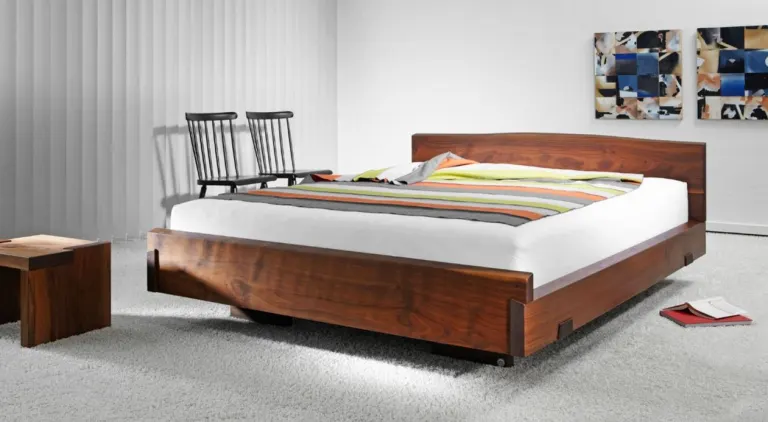
• Integrated Power & Fast-Charging Modules: Turkish CNC machining centers rout exact pockets into solid hardwood headboard side panels or floating nightstands to accept flush-mounted international power sockets, 65W USB-C PD fast-charging ports, and master guestroom lighting/curtain control keypads (compliant with UL, CE, or BS 1363 regional electrical codes).
• Concealed Low-Voltage LED Perimeter Grazing: Headboards designed to wash textured wall finishes with warm 2700K light incorporate extruded aluminum heat-sink channels recessed into the rear perimeter of the solid wood frame. Removable magnetic access hatches behind the nightstand zone allow hotel maintenance engineers to replace LED drivers in under two minutes without unbolting the headboard from the wall.
• Under-Bed Motion-Activated Nightlights: Low-voltage 24V PIR motion sensors routed into the recessed bed plinth automatically illuminate a soft floor-level glow when a guest steps out of bed at night, wired cleanly through concealed internal bores inside the solid beech bed frame.
Smart Hotel Wardrobes: Safes, Minibars, and Sensor Lighting
• Automated Door-Contact Lighting: Concealed magnetic reed switches or recessed micro-switches milled into the solid hardwood wardrobe jamb trigger vertical aluminum-profile LED strips the instant a door opens, eliminating battery-operated stick-on lights.
• Thermoelectric & Absorption Minibar Ventilation Chimneys: Incorporating a silent minibar inside a closed solid wood wardrobe requires engineered thermodynamics. Turkish CAD engineers design a double-wall rear ventilation plenum (minimum 50mm deep) with slotted intake grilles milled into the recessed bottom plinth and exhaust louvers routed into the top crown molding, ensuring compressor heat dissipates quietly without warping adjacent timber panels.
• Reinforced Safe Mounting Platforms: Electronic in-room laptop safes are bolted through reinforced 36mm solid beech or multi-ply structural shelves directly into the wardrobe’s rear wall-anchoring cleats so the safe cannot be pried loose.
3. Comparative Global Landed-Cost Economics: Turkey vs. Italy, China, and Vietnam
For hospitality CFOs and FF&E purchasing directors, evaluating bespoke mixed-material engineering, smart hospitality integration, and global landed-cost economics of Turkish solid wood hotel furniture requires analyzing the complete financial equation—from EXW unit pricing and tooling fees to ocean/road freight, import tariffs, and working-capital velocity.
Economic & Operational Metric Turkey (İnegöl / Ankara / Istanbul) Italy (Brianza / Veneto) China (Guangdong / Zhejiang) Vietnam (Binh Duong / Dong Nai)
EXW Unit Cost Index (Bespoke Solid Wood + Mixed Material) 100 (Baseline Benchmark) 165 – 210 (+65% to +110%) 85 – 95 (-5% to -15%) 82 – 92 (-8% to -18%)
EU Import Customs Duty 0% (A.TR Customs Union) 0% (Intra-EU) 0% – 2.7% (plus high freight) 0% (EVFTA, long transit)
UK Import Customs Duty 0% (UK–Turkey FTA) 0% (UK–EU TCA) 0% – 2% 0% (UKVFTA)
U.S. Import Customs Duty (Wooden Bedroom HS 9403.50) 0% (MFN Duty-Free) 0% (MFN Duty-Free) 25% Section 301 + up to 216% Anti-Dumping Duty 0% (MFN Duty-Free)
Transit Time to Western Europe 6 – 10 Days (Road Trailer) 2 – 5 Days (Road) 32 – 45 Days (Ocean) 30 – 42 Days (Ocean)
Transit Time to GCC / Middle East 10 – 16 Days (Multimodal/Sea) 14 – 22 Days (Sea) 22 – 30 Days (Sea) 20 – 28 Days (Sea)
Transit Time to U.S. East Coast 18 – 26 Days (Ocean) 14 – 20 Days (Ocean) 35 – 48 Days (Ocean) 32 – 45 Days (Ocean)
Custom MOQ Flexibility High (30–50 rooms) Moderate (30–80 rooms) Low (100–250+ rooms) Low (100–250+ rooms)
In-House Mixed-Material Agility (Stone + Brass + Solid Wood) Exceptional (Domestic marble, metal, and wood clusters) Exceptional High (Requires multi-factory consolidation) Moderate (Limited domestic marble/brass ecosystem)
Why Turkey Delivers Superior Capital Efficiency for Hotel Developers
1. Elimination of Tariff Traps (Especially for North America): For U.S. hospitality projects, Chinese wooden bedroom furniture remains crippled by Section 301 tariffs and Department of Commerce Anti-Dumping orders. Turkey’s 0% MFN tariff status under HTSUS 9403.50 immediately eliminates massive border tax liabilities while offering superior hardwood joinery.
2. Working Capital & Schedule Velocity: Shorter lead times and rapid transit (under 10 days to Europe; under 3 weeks to the Middle East) reduce the duration capital is tied up in Letters of Credit or progress deposits, while giving interior architects up to 6 additional weeks to finalize design submittals compared to East Asian procurement timelines.
3. Co-Located Natural Stone & Metalworking Supply Chains: Unlike Southeast Asian factories that must import natural marble slabs or specialized architectural brass profiles, Turkish factories sit minutes away from domestic marble quarries, PVD metal coating plants, and commercial textile mills—eliminating double freight and multi-vendor coordination markups on mixed-material dressers and headboards.
4. Lifecycle Cost Analysis (LCCA): CapEx vs. 15-Year Hotel OpEx
Savvy hotel asset managers evaluate FF&E procurement using 15-Year Lifecycle Cost Analysis (LCCA) rather than initial purchase price alone. A low-cost particleboard dresser with thin paper foil imported from a budget supplier may cost 30% less on Day 1, but within four years of luggage impacts, spilled toiletries, and housekeeping wear, the property faces costly room-out-of-order downtime and premature replacement CapEx.
Through bespoke mixed-material engineering, smart hospitality integration, and global landed-cost economics of Turkish solid wood hotel furniture, Turkish contract casegoods deliver dramatically lower total cost of ownership:
• Refinishable & Repairable Solid Hardwood Edges: Solid 10mm–20mm oak, beech, or walnut edge-bandings and solid legs can be spot-sanded and touch-up finished in-situ by hotel engineering teams, whereas chipped melamine or thin veneer edges require full panel replacement.
• Commercial-Grade European Kinematics: Specifying authentic Austrian/German soft-close undermount runners and 100,000-cycle concealed hinges prevents drooping wardrobe doors and jammed dresser drawers across a 12-to-15-year brand standard refresh cycle.
• Modular Component Swappability: Because Turkish CNC factories archive exact digital CAD/CAM toolpaths for every project, a hotel operator can order 15 replacement solid walnut dresser tops or 20 upholstered headboard inserts seven years after opening—machined to the exact millimeter and stained to the archived master control sample.
5. Step-by-Step Technical Specification Guide for Mixed-Material RFQs
To extract accurate, apples-to-apples bids from Turkish contract manufacturers when pursuing bespoke mixed-material engineering, smart hospitality integration, and global landed-cost economics of Turkish solid wood hotel furniture, procurement teams should include five technical annexes in their Request for Quotation (RFQ):
1. Timber & Substrate Schedule: Specify exact hardwood species (e.g., FAS Grade European White Oak), target moisture content (7.5%–9.0% MC), solid vs. thick-veneer zones (minimum 1.5mm saw-cut veneer on E1/CARB P2 birch plywood cores), and finish gloss level (e.g., 10-gloss dead matte 2K waterborne polyurethane).
2. Metal & Stone Specification Matrix: Define metal alloys (e.g., 304 stainless steel with brushed PVD champagne brass finish), stone quarry origin, slab thickness (20mm), edge profile (e.g., 3mm eased arris), and penetrating sealer brand.
3. Electrical & Smart-Room Submittal Pack: Attach mechanical cutout drawings and voltage specifications (110V UL vs. 230V CE/UK) for all bedside power modules, LED strip Kelvin temperatures (2700K, CRI >90), and wardrobe door switches.
4. Fire & Structural Compliance Matrix: State mandatory regional test standards (EN 13501-1 / ASTM E84 for wood finishes, BS 5852 Crib 5 / CAL 117 for upholstered headboard panels, EN 16139 for structural durability, and ASTM F2057 for dresser anti-tip stability).
5. Logistics & Packaging Basis: Define the exact Incoterms® 2020 delivery point (e.g., FCA İnegöl, FOB Gemlik, or DDP London/Frankfurt/Riyadh) and specify whether dressers ship rigid-assembled while bed frames and tall wardrobes ship Semi-Knock-Down (SKD).
6. Frequently Asked Questions (FAQ)
Can Turkish contract manufacturers supply UL-listed or UK/EU-certified electrical components pre-installed inside hotel headboards and wardrobes?
Yes. Tier-1 Turkish hospitality factories routinely pre-wire and install UL-listed (North America), CE-certified (Europe), and BS-compliant (UK/GCC) power outlets, USB-C chargers, and low-voltage LED lighting profiles directly into solid wood bed frames and wardrobes during assembly. Buyers can either approve factory-sourced European brands (such as Legrand, Schneider, or Häfele Loox) or supply client-specified faceplates for factory integration.
How do Turkish factories prevent natural marble tops on wooden dressers from cracking during ocean or road transport?
Natural stone tops are removed from the solid wood dresser carcass prior to packing and crated vertically on edge inside dedicated ISPM-15 heat-treated wooden A-frame crates lined with high-density EPS foam separators. Once delivered to the hotel guestroom, installation teams bed the stone onto the dresser’s steel-reinforced sub-top using flexible neutral-cure structural silicone.
Why is Turkey more cost-effective than Italy for luxury mixed-material hotel furniture?
Turkish contract manufacturers utilize the exact same Italian 5-axis CNC machinery (Biesse, SCM), Austrian/German hardware (Blum, Hettich), and European two-component finishes as luxury Italian factories in Brianza, while benefiting from substantially lower skilled labor overhead, domestic access to Anatolian hardwoods and world-renowned Turkish marble quarries, and 0% customs duties into the EU, UK, and U.S.
What is the typical warranty offered by Tier-1 Turkish manufacturers on mixed-material solid wood hotel casegoods?
Reputable export-oriented Turkish contract manufacturers provide a comprehensive 2-to-5-year commercial structural warranty covering solid wood joint integrity, moisture-related warping or splitting, PVD metal finish adhesion, and European hardware mechanical operation, backed by an agreed percentage of spare parts shipped with the initial order.