Bathroom Cabinets with Shutter-Style Doors: Ventilation Engineering, Louver Joinery, Moisture Protection, and Coastal Architectural Design Guide
Bathroom Cabinets with Shutter-Style Doors—also known in architectural millwork as louvered bathroom vanities and slatted linen towers—combine timeless Mediterranean, coastal, and neoclassical craftsmanship with a vital functional advantage: continuous passive airflow. Unlike solid flat-slab or sealed shaker doors that trap residual dampness inside cabinet boxes, Bathroom Cabinets with Shutter-Style Doors allow air to circulate freely around folded bath towels, washcloths, spare toiletries, and under-sink plumbing traps, preventing musty odors and fungal mildew growth in humid bath environments.
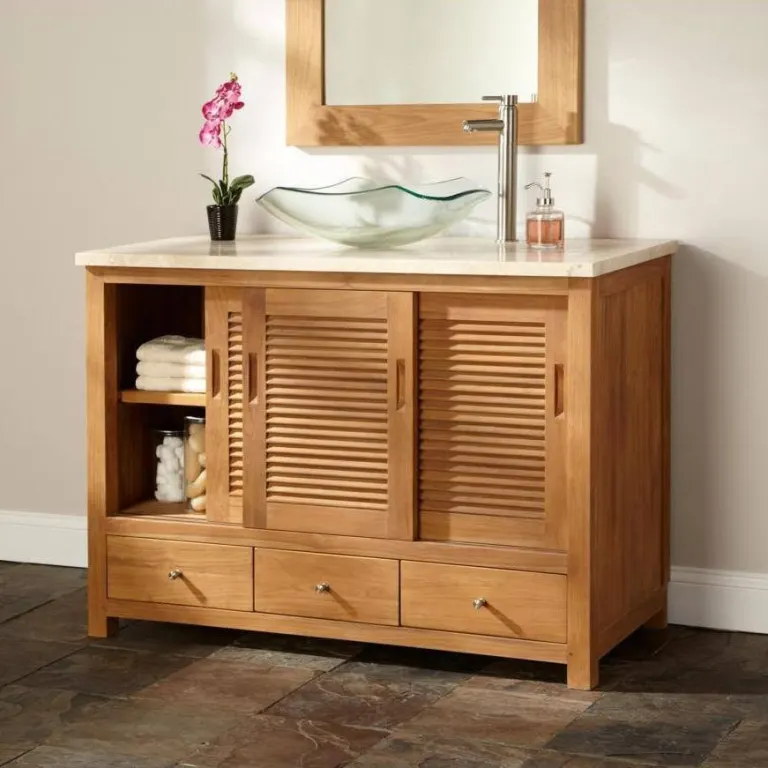
However, manufacturing and specifying Bathroom Cabinets with Shutter-Style Doors at an architectural standard is significantly more complex than producing standard flat-panel cabinetry. A single louvered vanity door contains dozens of individual angled slats, deep mortise slots, and narrow horizontal surfaces that are directly exposed to shower steam, water splashes, and airborne dust. Without precision CNC louver mortising, moisture-stabilized hardwood or HMR MDF substrates, and thorough catalytic spray penetration inside every louver gap, shutter-style doors can warp, swell at the louver joints, or trap grime. This comprehensive engineering and design guide examines the joinery mechanics, airflow physics, substrate selection, finishing chemistry, and maintenance protocols governing Bathroom Cabinets with Shutter-Style Doors.
1. Functional Engineering: True Open Louvers vs. False Closed Louvers
When evaluating or specifying Bathroom Cabinets with Shutter-Style Doors, the primary structural distinction lies between true open-slat ventilated louvers and false closed (decorative) louvers.
Design Feature True Open-Slat Louvered Doors False Closed (Faux-Louver) Doors
Structural Construction Individual angled slats (louvers) mortised at 30°–45° into solid vertical stiles with 4 mm–8 mm air gaps between slats. Slats overlap tightly with zero air gap, or grooves are CNC-routed into a single solid MDF/wood panel.
Passive Air Circulation High — enables continuous convective airflow through the cabinet interior. Zero — functions identically to a sealed solid cabinet door.
Best Bathroom Applications • Linen towers storing bath towels & robes
• Hamper pull-out cabinets
• Under-sink cabinets housing warm-water pipes • Vanity drawers storing cosmetics, cotton pads, or electronics that must remain dust-free
• High-splash zones next to open showers
Finishing & Cleaning Complexity High — requires multi-angle electrostatic or HVLP spray coating inside slat gaps and periodic microfiber/brush dusting. Low — easy to wipe down with a single pass of a damp microfiber cloth.
Airflow Physics in Humid Bath Microclimates
In bathrooms without 24-hour mechanical dehumidification, damp bath towels stored inside sealed cabinets create localized microclimates exceeding 80% relative humidity—ideal conditions for Aspergillus and Cladosporium mildew spores. Bathroom Cabinets with Shutter-Style Doors engineered with true 45-degree downward-angled louvers promote natural stack-effect air exchange while blocking direct water droplets from splashing inward onto stored linens.
2. Substrate Selection: Solid Hardwood vs. Green-Core HMR MDF
Because shutter-style doors possess a vastly greater surface-area-to-volume ratio than flat slab doors, moisture absorption can trigger rapid dimensional movement if the wrong core material is used.
Optimal Materials for Shutter-Style Bathroom Cabinetry
1. Kiln-Dried European White Oak (Quercus robur) & Thermo-Treated Ash (Fraxinus excelsior):
• Why It Excels: White oak features closed tyloses in its cellular vessels that resist liquid water intrusion, while thermally modified ash (heat-treated at 190°C–215°C) reduces Equilibrium Moisture Content (EMC) by 50%. Both species machine cleanly without splintering when routing narrow louver mortises.
2. Plantation Teak (Tectona grandis) & American Black Walnut (Juglans nigra):
• Why It Excels: Rich in natural hydrophobic heartwood oils, making them premier choices for luxury spa vanities and coastal residences.
3. Green-Core High Moisture Resistant (HMR) MDF (780–820 kg/m³):
• Why It Excels: When specifying painted or matte-lacquered Bathroom Cabinets with Shutter-Style Doors (such as classic crisp white RAL 9003, coastal sage green, or soft greige), solid timber frames paired with HMR MDF louvers—or monolithic CNC-routed 22 mm HMR MDF faux-louver doors—prevent seasonal joint cracking along paint lines.
4. High-Density PVC Foam Board (WPC):
• Why It Excels: 100% waterproof and impervious to direct shower spray, ideal for commercial pool locker rooms, beach-house wet rooms, and unventilated guest baths.
3. Precision Louver Joinery and Structural Door Engineering
A high-performance shutter-style door must resist twisting, louver rattling, and corner sag over tens of thousands of opening cycles. Master cabinetmakers enforce four strict structural standards:
1. Solid Stiles and Rails (20 mm – 22 mm Thickness)
Vertical stiles (55 mm–75 mm wide) and horizontal top, middle, and bottom rails must be milled from 6%–8% EMC kiln-dried hardwood joined with haunched mortise-and-tenon or cope-and-stick joints. For tall linen tower doors exceeding 1400 mm in height, incorporating a central horizontal divider rail divides the louver span into two rigid sections, eliminating mid-span slat flexing.
2. Mortised Slat Pockets vs. Surface-Pinned Slats
• Architectural Standard (CNC Mortised Pockets): Each louver slat (typically 6 mm–8 mm thick and 32 mm–45 mm wide with rounded 2 mm bullnose edges) is tenoned directly into 5 mm deep angled mortise slots milled into the inner edges of the vertical stiles, bonded with waterproof D4 PVAc or Polyurethane (PUR) woodworking adhesive.
• Budget Defect to Avoid: Low-tier mass-market shutter doors often secure louvers using thin metal pin nails shot from the outside stile edge, which rust in humid bathrooms and loosen over time.
3. Slat Pitch Angle (35° to 45° Downward Bevel)
Louvers must always be oriented tilting downward toward the exterior face at a 35° to 45° angle. This downward pitch deflects accidental sink splashes outward while obscuring direct eye-level sightlines into the cabinet interior for a clean, uniform architectural facade.
4. Carcass Waterproofing Standards
Pair shutter-style doors with 18 mm–20 mm phenolic marine plywood (su kontrası) or 18 mm green-core HMR MDF carcasses edge-banded with waterproof PUR hot-melt adhesive, supported by 8 mm–10 mm grooved structural back panels and anodized aluminum sink-base drip liners.
4. Multi-Angle Catalytic Coating Protocols for Louvered Fronts
The single most common manufacturing failure in Bathroom Cabinets with Shutter-Style Doors is incomplete paint or sealer coverage inside the narrow gaps between louvers. If raw wood or MDF fibers remain exposed on the undersides of slats, bathroom steam will wick directly into the core and swell the louvers.
Industrial Finishing Protocol
1. Pre-Assembly Slat Priming (For Multi-Coat Lacquer): Premier factories prime and sand individual louver slats before assembling them into the stile-and-rail frame, guaranteeing 100% film thickness inside the mortise pockets.
2. Electrostatic & Low-Pressure Multi-Angle Spraying: After assembly, doors pass through pressurized spray booths where technicians or multi-axis spray robots coat the door from four opposing 45-degree angles (top-down, bottom-up, left, and right) using two-component (2K) non-yellowing aliphatic acrylic-polyurethane or industrial UV-cured hardwax oil.
3. Sheen Selection for Louvered Doors: Specify Silk Satin (20–30 GU) or Smooth Super-Matte (5–8 GU) finishes. High-gloss lacquer is rarely recommended for shutter-style doors because bright specular reflections highlight tiny dust particles resting on angled slats.
5. Corrosion-Resistant Hardware and Wall-Hung Vanity Integration
Because Bathroom Cabinets with Shutter-Style Doors encourage air exchange throughout the interior, interior hinges and drawer slides are exposed to ambient bathroom humidity and must be corrosion-proof:
• AISI 304 Stainless Steel & Marine Nickel Concealed Hinges: Specify Blum Clip top Blumotion (stainless steel or Onyx Black editions), Hettich Sensys, or Salice Silentia+ soft-close hinges certified to EN ISO 9227 neutral salt-spray testing.
• Concealed Heavy-Duty Wall Brackets (Floating Shutter Vanities): Wall-hung shutter vanities require concealed steel suspension hangers (Camar 807 / Hettich SAH 216, rated 120–240 kg/pair) anchored into solid masonry or internal 2x8 timber wall blocking, elevating the wooden louvers 250 mm–350 mm above wet floor tiles.
• U-Shaped Plumbing Cutouts & Metal Drawer Boxes: For vanity drawers beneath basins, pair false-louver exterior drawer fronts with double-walled powder-coated steel drawer boxes (Blum Legrabox / Hettich ArciTech) or solid dovetail hardwood boxes featuring CNC-milled U-shaped P-trap cutouts trimmed in brushed anodized aluminum.
6. Architectural Styling and Easy-Maintenance Cleaning Strategies
Bathroom Cabinets with Shutter-Style Doors adapt effortlessly across diverse interior design movements:
• Modern Coastal & Mediterranean: Rift-sawn natural white oak or warm white (RAL 9010) matte-lacquered shutter vanities paired with honed travertine or white veined quartz countertops and brushed brass hardware.
• Contemporary Japandi & Spa Minimalism: Slim-slat thermo-treated ash or smoked walnut shutter doors integrated into handleless floating vanities with recessed warm-white (2700K) IP65 under-cabinet LED strips.
• Neoclassical & Transitional: Framed inset shutter linen towers paired with freestanding soaking tubs and polished nickel cross-handle fixtures.
Practical Maintenance Routine
To keep louvered slats spotless without laborious hand-wiping:
1. Weekly Dry Dusting: Pass a handheld vacuum brush attachment or electrostatic microfiber duster across the louvers in downward strokes.
2. Monthly Damp Wipe: Lightly mist a plush microfiber cloth with warm water and pH-neutral mild soap (never spray water directly onto open louvers), wipe along the slat faces, and immediately dry with a clean cloth.
3. Ventilation Pairing: Operate a humidistat-controlled bathroom exhaust fan (8–10 air changes per hour) during and after showers to maximize the passive drying efficiency of the shutter doors.